
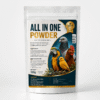
All in One Powder for Pet Birds – Canker, Coccidiosis, Respiratory & Worm Support – 100g
$39.95


Not for sale in California. This restriction is printed on the pack. Please do not order this product for delivery to a California address. Everything else in our bird antibiotics range is unaffected.
All in One Powder for Pet Birds: Directions, Coverage & Comparison Guide
Your pet bird looks fluffed up and less active, and its appetite or droppings have changed. You want to understand whether the problem involves canker, coccidiosis, a respiratory condition, or worms before choosing a product. Those concerns have different treatment targets, and similar signs can occur for different reasons. When a qualified avian veterinarian confirms which of them is involved, a combination product may simplify the plan. That is when bird keepers reach for All in One Powder.
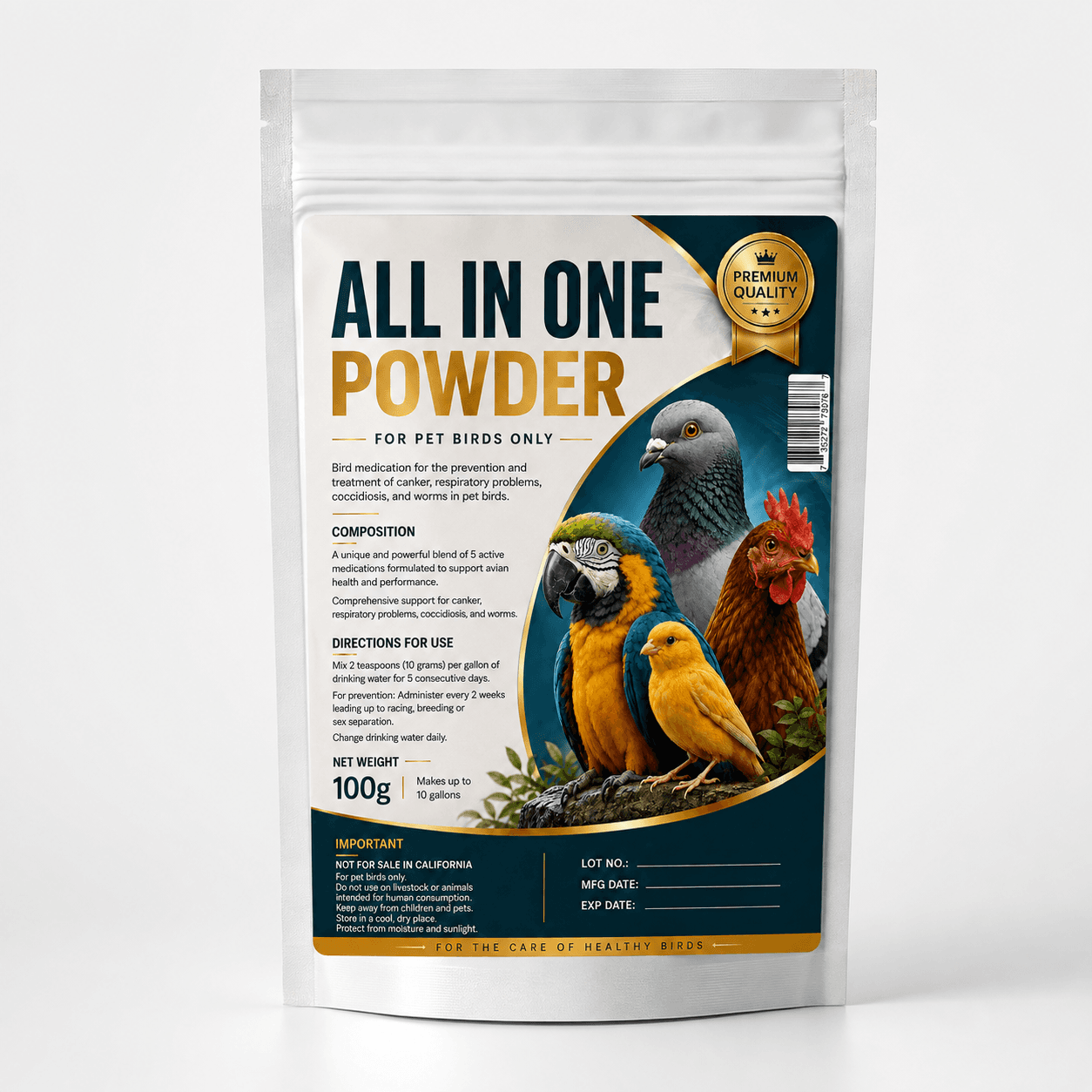
All in One Powder is a 100 g water-soluble powder labelled for the prevention and treatment of canker, respiratory problems, coccidiosis and worms in pet birds. The pack describes it as a blend of five active medications and gives full drinking-water directions. What it does not do is name those five actives, which shapes how the product should be used.
This guide covers what the label states, how to prepare the medicated water, the prevention schedule printed on the pack, how it compares with our single-ingredient products, and the recovery signs to discuss with an avian veterinarian.
Important Notice: All in One Powder is intended exclusively for pet birds. It is not for human use and not for poultry or other food-producing birds. Always consult a qualified avian veterinarian if you are unsure about diagnosis or treatment.
What Is All in One Powder?
All in One Powder is a 100 g powder for pet birds, mixed into drinking water. The label positions it for four concern areas at once — canker, respiratory problems, coccidiosis and worms — and describes the contents as a blend of five active medications formulated to support avian health and performance. At the labelled rate the pouch makes up to 10 gallons of medicated water.
The pack does not name the five active medications or give their strengths. That is worth being plain about, because it has three practical consequences. You cannot check whether a second product you are giving repeats one of the same actives. Your veterinarian cannot match a specific component to a specific diagnosis. And if a bird has reacted badly to a medication before, you cannot confirm whether this pouch contains it. If you need the composition, contact us with the lot number from your pouch and speak to an avian veterinarian before dosing.
Do not assume that directions for a different “all in one” bird product apply to this one. Combination products differ in what they contain and how much of each. The 100 g pack size tells you how much powder is in the pouch; the directions below tell you how to use it.
Product Details at a Glance
| Attribute | Details |
|---|---|
| Active ingredients | Described on the pack as a blend of 5 active medications; the individual actives and strengths are not named on the label |
| Labelled for | Canker, respiratory problems, coccidiosis and worms in pet birds |
| Formulation | Water-soluble powder for drinking water |
| Pack size | 100 g, making up to 10 gallons of medicated water |
| Treatment directions | 2 teaspoons (10 grams) per gallon of drinking water for 5 consecutive days; change the water daily |
| Prevention directions | Every 2 weeks leading up to racing, breeding or sex separation |
| Sales restriction | Not for sale in California (printed on the pack) |
| Regulatory status (USA) | Supplied over the counter for pet birds. Not an FDA-approved animal drug — see our legal and regulatory information |
| Storage | Store in a cool, dry place. Protect from moisture and sunlight. Keep away from children and pets |
What All in One Powder Is Labelled For
The pack names four concern areas. The sections below describe what each one is and what an owner typically sees, so you can describe the problem accurately to an avian veterinarian. Because the five actives are not named on the pack, none of these sections can tell you which component addresses which concern.
Canker
Canker — trichomoniasis — affects the mouth, throat and crop, and is a familiar problem in pigeon lofts and some pet birds. Owners often notice reluctance to eat, repeated swallowing, a change in the sound of the bird’s breathing, or visible material in the mouth. Canker is caused by a protozoan rather than a bacterium, which is why it needs an antiprotozoal rather than an antibiotic. If you can see lesions in a bird’s mouth, have an avian veterinarian examine it.
Coccidiosis
Coccidiosis is an intestinal protozoal infection. Loose or discoloured droppings, weight loss despite eating, and a generally unthrifty bird are common signs, and it spreads through droppings in crowded or damp conditions. Droppings that look wrong are worth a veterinary assessment rather than a guess: several very different problems produce similar droppings.
Respiratory Problems
Respiratory signs in birds range from sneezing and nasal discharge to wheezing, tail bobbing and open-mouth breathing. The causes range just as widely — bacteria, Mycoplasma, Chlamydia, fungi, parasites, and simple air quality. A bird working hard to breathe is an emergency, not a case for trying a powder first. Our guide to the antibacterial classes explains why matching the class to the organism matters.
Worms
Internal worms — roundworms, hairworms and others — are picked up from contaminated ground and shared feeders. Signs are often vague: weight loss, poor condition, reduced performance in racing birds. A faecal examination by a veterinarian identifies which worms are present, and different worms respond to different actives.
The Appeal and the Limit of One Combined Product
A single pouch covering four concern areas is convenient, and for loft keepers running a pre-season programme that convenience is the point. The limit is the other side of the same coin: a combination treats things your bird may not have, and because the actives are unnamed you cannot tell which of the four concerns any one dose is actually addressing. Where a veterinarian has identified a single problem, a product that names its ingredient is easier to use well.
All in One Powder Dosage and Administration
The pack gives two schedules: a treatment course and a prevention course. Both are drinking-water directions. Confirm which applies to your bird with an avian veterinarian who has assessed it.
Dosage Chart
| Use | Amount of product | Drinking water volume | Schedule |
|---|---|---|---|
| Treatment | 2 teaspoons (10 grams) | 1 US gallon (3.785 liters) | 5 consecutive days, changing the water daily |
| Prevention | 2 teaspoons (10 grams) | 1 US gallon (3.785 liters) | Every 2 weeks leading up to racing, breeding or sex separation |
Those directions are printed on the pack. A 100 g pouch makes up to 10 gallons of medicated
water at that rate. The label does not give a reduced measure for a smaller drinker, so ask an
avian veterinarian how to scale it rather than estimating a fraction of a teaspoon.
How to Administer All in One Powder
- Have an avian veterinarian assess the bird and confirm which concern is actually present.
- Check the directions on the pouch you received against the schedule below.
- Measure 2 teaspoons (10 grams) of powder for each gallon (3.785 liters) of drinking water you are preparing.
- Dissolve it in fresh drinking water and offer it as the bird’s water supply.
- Change the drinking water daily, preparing a fresh mixture each time.
- Complete the 5 consecutive days, and observe appetite, drinking, droppings and breathing throughout.
- Seek veterinary reassessment if the bird worsens at any point, or if it is not drinking.
The Prevention Schedule
The label also gives a preventive use: administer every 2 weeks leading up to racing, breeding or sex separation. That reflects how loft keepers use combination products ahead of the stress points in a season. Preventive dosing is not free of consequence — routine antimicrobial use selects for resistant organisms — so discuss a prevention programme with an avian veterinarian rather than running one by default.
Mixing Into Soft Food or Dosing by Mouth
The pack gives drinking-water directions only. It does not provide a dose or method for mixing the powder into soft food or giving it directly by mouth, and a bird may eat only part of a serving. If your bird is not drinking reliably, ask an avian veterinarian for an appropriate route rather than adapting the water measure.
Preparing Medicated Water
- Use the label measure: 2 teaspoons (10 grams) per gallon (3.785 liters). A 100 g pouch makes up to 10 gallons at that rate.
- Prepare fresh water daily: Change the drinking water every day for the 5 days of the course.
- Watch drinking: Medicated water can taste different. A bird that stops drinking receives neither fluid nor medication.
- Keep the waterer clean and shaded: Out of direct sunlight, and washed between preparations.
- Observe the bird: Track drinking, appetite, activity, droppings and breathing so changes can be reported to an avian veterinarian.
- Seek help for breathing difficulty: Open-mouth breathing or persistent tail bobbing warrants prompt professional assessment.
Safety and Precautions
The Five Actives Are Not Named on the Pack
Because the five actives are unnamed, two ordinary safety checks are not available to you: confirming that a second medication does not repeat one of the same ingredients, and checking the pouch against a known sensitivity. Treat that as a reason to involve a veterinarian rather than to combine products, and keep the pouch itself so the lot number can be traced.
Not for Sale in California
The pack is printed “NOT FOR SALE IN CALIFORNIA”. Please do not order it for delivery to a California address. State rules on animal medications differ, and a restriction printed on a pack is the manufacturer telling you where it may not be sold. If you are in California, the single-ingredient products in our range are not affected.
Pet Birds Only
This product is labelled for pet birds only. Do not use it on livestock or on animals intended for human consumption — that includes chickens, ducks, quail and turkeys kept for eggs or meat. Keep it away from children and other pets.
Treat Only What the Bird Has
A combination product invites treating a bird for four things when it has one. Unnecessary courses select for resistant organisms and expose the bird to actives it did not need. Where a veterinarian has identified a single problem, a single-ingredient product is usually the better choice, and our range has one for most of these targets.
Storage and Shelf Life
Store the pouch in a cool, dry place, protected from moisture and sunlight, and keep it away from children and pets — those are the storage instructions printed on the label. Check the lot number, manufacture date and expiry date on your pouch before use, and do not use the product past its expiry. Mixed medicated water is not kept: the label directs fresh drinking water daily.
All in One Powder vs. Our Single-Ingredient Products
All in One Powder covers four concern areas in one pouch. Our other bird products each name their active ingredient and strength, which lets a veterinarian match the product to a diagnosis and lets you check for overlap between products. The table sets out those roles.
| Product | Active ingredient | Drug class | Best for | When to choose |
|---|---|---|---|---|
| All in One Powder (this product) | Blend of 5 active medications; not named on the pack | Combination | Canker, respiratory problems, coccidiosis and worms | A loft programme on veterinary advice, rather than an unidentified illness |
| Vetafarm Trizole | Combination antiprotozoal | Antiprotozoal | Canker, coccidiosis, giardia, hexamita | Protozoal problems in racing and show pigeons |
| Vetafarm Trizole | Combination antiprotozoal | Antiprotozoal | Canker, coccidiosis, giardia, hexamita | A confirmed protozoal infection of the mouth, crop or gut |
| Ivermectin 0.02% Oral Solution | Ivermectin 0.2 mg/mL | Avermectin antiparasitic | Scaly face or leg mites, air sac mites, roundworms, Capillaria, lice | Identified parasites, not bacterial infections |
| Tylosin Powder | Tylosin tartrate 99% | Macrolide antibiotic | Mycoplasma, chronic respiratory disease, sinusitis, conjunctivitis | Respiratory signs where Mycoplasma is suspected |
| Doxycycline 20% Powder | Doxycycline 20% (200 mg/g) | Tetracycline antibiotic | Psittacosis, Mycoplasma, bacterial respiratory infections | Suspected psittacosis or broader respiratory coverage |
| Doxy-Tyl Powder | Tylosin 40% + doxycycline 20% | Macrolide + tetracycline combination | Mixed respiratory infections, Chlamydia + Mycoplasma | When both organisms may be involved |
| Enrofloxacin 10% Powder | Enrofloxacin | Fluoroquinolone antibiotic | E. coli, Salmonella, Pasteurella, gram-negative infections | Severe or systemic gram-negative bacterial infections |
| Amoxicillin 10% Powder | Amoxicillin | Penicillin (beta-lactam) | Susceptible bacterial infections in pigeons and pet birds | When a veterinarian indicates a beta-lactam |
Our recommendation: Get a diagnosis first. If your bird has one identified problem, a product that names its active ingredient is easier to dose, easier to combine safely, and easier for a veterinarian to assess. All in One Powder earns its place as a loft-programme product where a keeper is following a routine ahead of racing or breeding, on veterinary advice — not as a first response to a sick bird whose problem has not been identified.
Compatibility and Drug Interactions
Compatibility with another medication cannot be assessed from this pack, because the five actives are not named. That is not a theoretical problem: giving this powder alongside a single-ingredient antibiotic or antiprotozoal risks doubling a dose without knowing it. Ask an avian veterinarian to review both products before combining them, and give probiotics after a course rather than during it.
Signs of Recovery and When to Seek Veterinary Help
What Recovery Looks Like
A recovering bird is less fluffed up and more alert. Appetite and drinking return to normal, usual activity and vocalizing resume, and droppings return to their normal colour and consistency. Breathing becomes quiet, without tail bobbing or open-mouth breathing. The label does not state how quickly those changes should appear, so judge progress on the signs rather than on a number of days.
When to Seek Professional Help
Seek prompt avian veterinary help if the bird has open-mouth breathing, persistent tail bobbing, poor drinking, worsening activity, or signs that continue despite treatment. The Association of Avian Veterinarians (AAV) can help you locate an avian veterinarian. The American Veterinary Medical Association (AVMA) and Merck Veterinary Manual provide additional veterinary information.
What to Check on the Pack
This pouch is labelled simply All in One Powder, for pet birds only. Whatever pack you buy, and wherever you buy it, these are worth checking before you dose a bird:
- The directions: amount per gallon, number of days, and how often to change the water.
- The net weight and how many gallons it makes, so you know you are measuring at the right rate.
- The storage instructions and any sales restriction printed on the pack.
- A lot number, manufacture date and expiry date. On the artwork we photograph, those lines are printed blank and filled in per batch — check the pouch you receive and contact us if any of them is missing.
- Whether the actives are named. If they are, keep that information with the pouch.
Regulations and Legal Considerations
Use the product only after an avian veterinarian has identified what the bird actually has. This page concerns pet birds, not poultry or other food-producing birds. The pack states that it is not for sale in California, and regulations vary elsewhere, so buyers should verify the requirements that apply where they live. See our legal and regulatory information.
Frequently Asked Questions About All in One Powder
These answers cover the label directions, what the pack does and does not tell you, and where a veterinarian has to make the call.
What is All in One Powder for pet birds?
It is a 100 g water-soluble powder labelled for the prevention and treatment of canker, respiratory problems, coccidiosis and worms in pet birds. The pack describes it as a blend of five active medications and makes up to 10 gallons of medicated water.
What ingredients are in All in One Powder?
The pack states that it contains five active medications but does not name them or give their strengths. If you need the composition – for example to avoid doubling up with another product, or because your bird has reacted to something before – contact us with the lot number and ask your avian veterinarian before dosing.
How much All in One Powder do I put in my bird’s water?
The pack directs 2 teaspoons (10 grams) per gallon (3.785 liters) of drinking water for 5 consecutive days, changing the water daily. A 100 g pouch makes up to 10 gallons at that rate.
How long should I give All in One Powder to my bird?
The label states 5 consecutive days for treatment. For prevention it directs dosing every 2 weeks leading up to racing, breeding or sex separation. Confirm which applies to your bird with an avian veterinarian.
Can All in One Powder treat canker in birds?
Canker is one of the four concerns named on the pack. Because the five actives are not listed, the page cannot tell you which component addresses it or at what strength. If you can see lesions in a bird’s mouth, have an avian veterinarian examine it and confirm the treatment.
Can All in One Powder treat coccidiosis in birds?
Coccidiosis is named on the pack as one of the four concerns. Loose or discoloured droppings have several possible causes, so confirm the diagnosis before treating – a faecal examination settles it quickly.
Does All in One Powder cover respiratory infections?
Respiratory problems are named on the pack. Respiratory signs in birds have many causes – bacteria, Mycoplasma, Chlamydia, fungi, parasites and air quality – and a bird working hard to breathe needs prompt veterinary assessment rather than a powder tried first.
Does All in One Powder remove worms?
Worms are the fourth concern named on the pack. Different worms respond to different actives, and a faecal examination identifies which are present, so ask your veterinarian to confirm before and after treatment.
Is All in One Powder an antibiotic?
It is described as a blend of five active medications covering both bacterial and parasitic concerns, but the pack does not name them or their classes, so it cannot accurately be called simply an antibiotic.
Can I mix All in One Powder into soft food or give it by mouth?
The pack gives drinking-water directions only. It does not provide a soft-food or direct oral dose, so ask an avian veterinarian for an individual plan rather than adapting the water measure by guesswork.
Can I use All in One Powder alongside another medication?
Not without veterinary advice. Because the five actives are unnamed, neither you nor we can check whether a second product repeats one of them, and doubling up on a class is how birds get hurt. Give your veterinarian both packs to look at.
Why is this product not for sale in California?
The pack is printed “NOT FOR SALE IN CALIFORNIA”. Please do not order it for delivery to a California address. State rules on animal medications vary, and where a pack carries a restriction we pass it on to you.
Can All in One Powder be used for chickens or other poultry?
No. The pack states pet birds only and must not be used on livestock or animals intended for human consumption. That includes chickens, ducks, quail and turkeys kept for eggs or meat.
Conclusion
All in One Powder is a 100 g water-soluble powder labelled for canker, respiratory problems, coccidiosis and worms in pet birds, described on the pack as a blend of five active medications. The directions are 2 teaspoons (10 grams) per gallon of drinking water for 5 consecutive days, changing the water daily, with a preventive schedule every 2 weeks ahead of racing, breeding or sex separation.
The pack does not name the five actives, so keep it for any veterinary consultation, do not combine it with another medication without advice, and remember that it is not for sale in California. Have a bird with breathing difficulty, visible mouth lesions or abnormal droppings assessed rather than treated on a guess.
Ready to treat? All in One Powder for Pet Birds, 100 g, is in stock and dispatched the same business day on orders placed before 2:00 PM ET, shipped tracked within the United States. Not available for California addresses.
Related Products
These products each name their active ingredient, which makes them easier to match to a diagnosis.
- Vetafarm Trizole — for canker, coccidiosis, giardia and hexamita in racing and show pigeons.
- Vetafarm Trizole — bird antiprotozoal for canker, coccidiosis, giardia and hexamita.
- Ivermectin 0.02% Oral Solution — for identified mites, worms and lice.
- Tylosin Powder — for suspected Mycoplasma-related respiratory signs.
- Browse all bird antibiotics or read our guide to the antibacterial classes.
External Resources
Consult these organizations alongside advice from a veterinarian who can assess your bird.
- Association of Avian Veterinarians (AAV)
- American Veterinary Medical Association (AVMA)
- Merck Veterinary Manual
- FDA Center for Veterinary Medicine
Disclaimer: This article is for educational purposes only and does not constitute veterinary advice. All in One Powder and all products discussed are intended exclusively for pet birds. They are not for human consumption or for use in poultry or other food-producing animals. Consult a qualified avian veterinarian for diagnosis and treatment recommendations.
Be the first to review “All in One Powder for Pet Birds – Canker, Coccidiosis, Respiratory & Worm Support – 100g”
Related products

Fish Antibiotics

Bird Antibiotics
Baytril 10% Oral Solution for Pet Birds & Small Animals – Enrofloxacin 100 mg/mL – 25 mL

Our Antibiotics


Fish Antibiotics
Bird Antibiotics
Amoxicillin 10% Powder for Birds – Broad-Spectrum Support for Pigeons & Pet Birds – 100 g
Fish Antibiotics
Reviews
There are no reviews yet.