
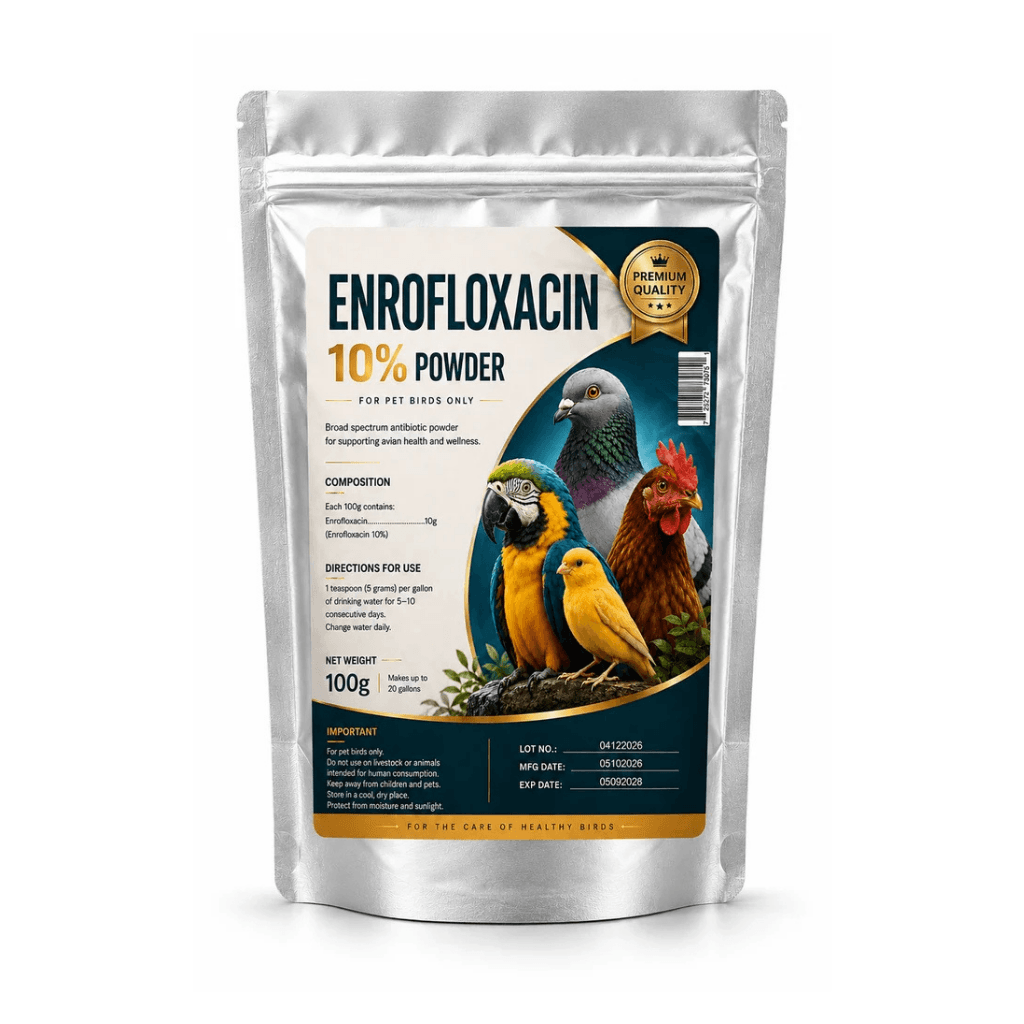
Enrofloxacin 10% Powder for Pet Birds – Avian Antibiotic Powder 100g
$39.95


Enrofloxacin 10% Powder (100 mg per gram) for Pet Birds: Complete Dosage, Treatment & Comparison Guide
Your bird is fluffed up, less active, and eating poorly. Its droppings have become watery, or you notice nasal discharge and difficult breathing. These changes can have several causes, but a serious bacterial infection needs prompt assessment. A bite or scratch from a cat is especially urgent, even if the wound looks small. When an avian veterinarian suspects a susceptible gram-negative bacterial infection and selects enrofloxacin, an accurately administered product becomes part of the treatment plan. That is when bird keepers reach for Enrofloxacin 10% Powder.
Enrofloxacin 10% Powder contains 100 mg of enrofloxacin per gram. Enrofloxacin is a bactericidal fluoroquinolone antibiotic with its strongest activity against gram-negative bacteria, including E. coli, Salmonella and Pasteurella. It is also active against Mycoplasma, with limited activity against anaerobic bacteria. Its place in our range is the stronger gram-negative option, for use when a veterinarian has decided this antibiotic and this route suit the bird’s condition.
This guide covers what the product is for, how it works, the label directions for medicated drinking water, safety precautions, comparisons with our other bird medications, and the signs that call for veterinary help.
Important Notice: Enrofloxacin 10% Powder is intended exclusively for pet birds. It is not for human use and not for poultry or other food-producing birds. Always consult a qualified avian veterinarian if you are unsure about diagnosis or treatment.
What Is Enrofloxacin 10% Powder?
Enrofloxacin 10% Powder is a water-soluble fluoroquinolone antibiotic powder for pet birds. Each 100 g contains 10 g of enrofloxacin — 10%, or 100 mg per gram — and the pouch makes up to 20 gallons of medicated water at the labelled rate. Its spectrum is broad, with its strongest role against gram-negative bacteria such as E. coli, Salmonella and Pasteurella. Mycoplasma is also covered, while activity against anaerobic bacteria is limited.
Unlike the bacteriostatic respiratory powders in our range, enrofloxacin is bactericidal. It inhibits bacterial DNA gyrase and topoisomerase IV, stopping DNA replication so susceptible bacteria die. That mechanism explains its distinct place among our bacterial treatment options. It does not establish that every ill bird needs a fluoroquinolone, or that a water-based dose will reach a bird that is drinking poorly.
The label directs dissolving the powder in fresh drinking water: 1 teaspoon (5 grams) per gallon (3.785 liters) for 5 to 10 consecutive days, changing the water daily. It does not give directions for mixing the powder into food or giving it directly by mouth. The 10% strength describes what is in the powder; it does not tell you how much an individual bird will drink, which is why a bird that is drinking poorly needs veterinary attention rather than a stronger mix.
Product Details at a Glance
| Attribute | Details |
|---|---|
| Active ingredient | Enrofloxacin 10% (100 mg per gram); 10 g per 100 g |
| Drug class | Fluoroquinolone antibiotic |
| Mechanism | Bactericidal; inhibits bacterial DNA gyrase and topoisomerase IV, stopping DNA replication |
| Formulation | Water-soluble powder |
| Pack size | 100 g, making up to 20 gallons of medicated water |
| Spectrum of activity | Broad; strongest against gram-negative bacteria including E. coli, Salmonella and Pasteurella; also active against Mycoplasma; limited anaerobic activity |
| Directions | 1 teaspoon (5 grams) per gallon of drinking water for 5 to 10 consecutive days; change the water daily |
| Common brand names | Sold as Enrofloxacin 10% Powder; the pack carries no separate brand name |
| Regulatory status (USA) | Supplied over the counter for pet birds. Not an FDA-approved animal drug, and extra-label fluoroquinolone use in food-producing animals is prohibited in the US — see our legal and regulatory information |
| Known side effect | Medicated water may taste bitter and reduce drinking |
| Storage | Store in a cool, dry place. Protect from moisture and sunlight. Keep away from children and pets |
Common Bird Diseases Treated by Enrofloxacin 10% Powder
Enrofloxacin 10% Powder is intended for susceptible bacterial conditions, particularly those involving the gram-negative organisms below. The same visible sign can occur with different causes, and bacterial susceptibility cannot be judged from appearance. Have an avian veterinarian assess a sick bird and choose a route that can actually deliver the intended dose.
Colibacillosis
Colibacillosis is associated with Escherichia coli. A bird may appear lethargic and fluffed up, have diarrhoea, and sometimes show respiratory signs. E. coli is among the gram-negative bacteria in enrofloxacin’s spectrum, which is why the product may be considered when an avian veterinarian suspects or confirms a susceptible infection. Those signs do not identify E. coli by themselves, and a bird with diarrhoea may not drink a predictable amount of medicated water.
Salmonellosis and Paratyphoid
Salmonellosis, or paratyphoid, is associated with Salmonella species. Signs include watery or greenish droppings, weight loss, and swollen joints or wing joints, particularly in pigeons. Salmonella is another named gram-negative target. A veterinarian should assess the bird and determine whether this formulation and route fit the infection; a change in droppings or a swollen joint alone cannot establish the diagnosis.
Pasteurella Infections and Cat-Related Injuries
Pasteurella infections are associated with Pasteurella multocida, and cat bites and scratches are the classic route. A cat-injured bird is an emergency. Pasteurella can cause sudden, severe illness, the puncture wounds are often tiny and easy to miss under feathers, and the outcome depends on how quickly treatment starts. Enrofloxacin’s spectrum includes Pasteurella, but the correct response to a cat bite or scratch is immediate veterinary care — not putting powder in the water and waiting to see what happens.
Bacterial Respiratory Infections
Sneezing, nasal discharge or laboured breathing may prompt investigation of a bacterial respiratory infection. Mycoplasma is among the organisms enrofloxacin can target, and its gram-negative activity may also be relevant when a veterinarian identifies a susceptible bacterial cause. Because respiratory signs have many causes, the product should be selected for the assessed organism rather than for sneezing alone. Our guide to the antibacterial classes explains how the classes differ.
Bacterial Enteritis
Bacterial enteritis presents with diarrhoea, poor appetite and weight loss. Several different bacteria can be responsible, and the pack does not name one, so enrofloxacin fits only where a veterinarian has identified a susceptible organism within its spectrum. Poor appetite and altered drinking make it especially important to confirm that medicated water can actually deliver the treatment to that bird.
Why Enrofloxacin Has a Distinct Gram-Negative Role
Enrofloxacin is the bactericidal fluoroquinolone in our range, positioned for severe or systemic gram-negative bacterial infections. Its targets include E. coli, Salmonella and Pasteurella, whereas our other bird products have more focused respiratory, protozoal or parasitic roles. That distinction calls for careful use: the product’s breadth and its importance in medicine are reasons to establish a likely bacterial cause and finish a verified course, not reasons to reach for it whenever a bird looks unwell.
How Does Enrofloxacin 10% Powder Work?
Enrofloxacin kills susceptible bacteria by inhibiting DNA gyrase and topoisomerase IV. Blocking those enzymes stops bacterial DNA replication. This bactericidal mechanism distinguishes it from the bacteriostatic tylosin and doxycycline products in our range. Its strongest activity is against gram-negative bacteria, with additional Mycoplasma activity and limited anaerobic activity.
Key advantages and limits include:
- Bactericidal mechanism: It kills susceptible bacteria rather than only stopping their growth.
- Gram-negative focus: E. coli, Salmonella and Pasteurella are the principal named targets.
- Mycoplasma activity: Mycoplasma is also in the spectrum, although the best choice depends on the assessed condition.
- Known concentration: The powder contains 100 mg of enrofloxacin per gram, so a level teaspoon (5 grams) carries 500 mg of enrofloxacin into a gallon of water.
- Water-soluble form: It is prepared as fresh medicated drinking water, replaced every 24 hours.
- Spectrum limits: It does not treat fungi, viruses or parasites, and its activity against anaerobic bacteria is limited.
Enrofloxacin 10% Powder Dosage and Administration
The pack states 1 teaspoon (5 grams) per gallon (3.785 liters) of drinking water for 5 to 10 consecutive days, with the water changed daily. Follow that measure and confirm the course with an avian veterinarian who has assessed your bird. Enrofloxacin is an important antibiotic, and the case for using it should be a diagnosis rather than a guess.
Dosage Chart
| Amount of product | Drinking water volume | Frequency | Duration |
|---|---|---|---|
| 1 teaspoon (5 grams), delivering 500 mg of enrofloxacin | 1 US gallon (3.785 liters) | Change the water daily | 5 to 10 consecutive days |
Those directions are printed on the pack. A 100 g pouch makes up to 20 gallons of medicated
water at that rate. The label does not give a reduced measure for a smaller drinker, so ask an
avian veterinarian how to scale it rather than estimating a fraction of a teaspoon.
Measure only the directed amount. Prepare fresh medicated water every 24 hours, and treat it as the bird’s only water source during the course. Watch intake closely, because the water may taste bitter.
How to Administer Enrofloxacin 10% Powder
- Have an avian veterinarian assess the bird and determine whether a susceptible bacterial condition makes enrofloxacin appropriate.
- For a cat bite or scratch, seek immediate veterinary care rather than starting home water treatment and waiting for a response.
- Measure 1 teaspoon (5 grams) of powder for each gallon (3.785 liters) of drinking water you are preparing.
- Dissolve it in fresh drinking water and offer it as the only water source during treatment.
- Remove mineral blocks, cuttlebone, grit and mineral supplements for the duration, with veterinary guidance on the bird’s diet.
- Observe whether the bird drinks the prepared water, replacing it with a fresh mixture every 24 hours.
- Complete the course of 5 to 10 consecutive days as directed, and seek reassessment if symptoms worsen or intake is uncertain.
Mixing Into Soft Food or Dosing by Mouth
The pack gives drinking-water directions only. It does not provide a dose or method for mixing the powder into soft food or giving it directly by mouth, and a bird that eats only part of a serving receives an uncertain amount. If your bird is not drinking reliably, ask an avian veterinarian for an appropriate route rather than adapting the water measure.
Preparing Medicated Water and a Hospital Cage
- Use the label measure: 1 teaspoon (5 grams) per gallon (3.785 liters). A 100 g pouch makes up to 20 gallons at that rate.
- Prepare fresh water: Dissolve the directed amount in fresh drinking water every 24 hours.
- Observe intake: Medicated water may taste bitter. Watch whether the bird actually drinks it.
- Use medicated water as the only source: During water-based treatment, it should be the bird’s only water.
- Address minerals: Remove mineral blocks, cuttlebone, grit and mineral supplements. Discuss changes to the bird’s nutritional plan with its avian veterinarian.
- Track signs: Note appetite, activity, droppings, breathing, and whether the bird looks more or less fluffed up.
- Escalate promptly: A cat bite or scratch, worsening breathing, or poor drinking calls for veterinary help rather than continued reliance on a waterer.
Step-by-Step Treatment Guide
Treatment moves from an assessed bacterial concern to the label dose, followed by daily checks that the bird drinks and improves.
Step 1: Confirm the Problem Matches What Enrofloxacin 10% Powder Treats
Describe lethargy, diarrhoea, altered droppings, swollen joints, nasal discharge or difficult breathing to an avian veterinarian. The targets include E. coli, Salmonella, Pasteurella and Mycoplasma. These signs overlap with other conditions, so a symptom list cannot prove that the bird has a susceptible bacterial infection.
Step 2: Know When to Choose Enrofloxacin 10% Powder
Consider this product when an avian veterinarian identifies or strongly suspects a bacterial condition within enrofloxacin’s spectrum and decides the powder’s route is appropriate. Its main role is gram-negative infection. A focused Mycoplasma concern may point to Tylosin Powder, a suspected psittacosis to Doxycycline 20% Powder, and a mixed respiratory picture to Doxy-Tyl Powder.
Step 3: Set Up a Hospital Cage
Arrange a space that lets you watch the bird’s drinking, appetite, droppings, activity and breathing. Ask an avian veterinarian how to manage other birds if several are affected. A bird with a cat-related wound needs urgent care; cage observation and medicated water must not delay that assessment.
Step 4: Measure and Give the First Dose
Measure 1 teaspoon (5 grams) of powder per gallon (3.785 liters) of fresh drinking water, dissolve it, and offer it as the only water source. Do not carry a dose across from the 2.5% or 10% oral solutions — those are liquids measured in millilitres and the numbers do not translate.
Step 5: Maintain the Daily Treatment Cycle
Replace the drinking-water mixture with a fresh preparation every 24 hours. Follow the labelled course of 5 to 10 consecutive days. Watch that the bird continues to drink. If intake is uncertain, contact an avian veterinarian rather than assuming the intended amount has been delivered.
Step 6: Monitor for Improvement
Look for a bird that is less fluffed up and more alert, resumes eating and drinking, becomes active and vocal again, has droppings returning to their usual appearance, and breathes quietly without tail bobbing or open-mouth breathing. The label does not state how quickly improvement should appear. Worsening signs call for reassessment.
Step 7: Complete the Full Course
Follow the full course confirmed for your bird by an avian veterinarian; the pack states 5 to 10 consecutive days. Completing it matters: stopping a fluoroquinolone early leaves the least susceptible bacteria behind, which is how resistance builds. Do not extend treatment on your own or repeat a course without reassessing the bird.
Step 8: Post-Treatment Recovery
Continue watching activity, appetite, drinking, droppings and breathing after the course. Give probiotics after the antibiotic course finishes, to help restore gut flora, rather than during it. Seek veterinary reassessment if symptoms persist or return rather than automatically restarting enrofloxacin.
Safety, Side Effects, and Precautions
The main precautions concern mineral binding, bitter-tasting water, responsible fluoroquinolone use, food-producing animals, and conditions outside the product’s spectrum.
Mineral Binding
Calcium, magnesium and iron reduce enrofloxacin absorption. Remove mineral blocks, cuttlebone, grit and mineral supplements during treatment. Discuss dietary changes with an avian veterinarian, particularly where an individual bird’s nutritional needs and the course length have to be balanced.
Bitter-Tasting Medicated Water
The prepared water may taste bitter and reduce drinking. A bird that avoids the water receives too little fluid and too little medication. Observe actual drinking throughout the course rather than assuming a filled waterer means intake. Contact an avian veterinarian promptly if drinking falls.
Not for Food-Producing Birds
This product is for pet birds only. US rules prohibit extra-label fluoroquinolone use in food-producing animals. Do not use Enrofloxacin 10% Powder in poultry or in birds raised for eggs or meat, and do not apply anything on this page to a food-producing flock.
Responsible Fluoroquinolone Use
Fluoroquinolones are among the antibiotics human and veterinary medicine most need to keep working. Use enrofloxacin only for a confirmed or strongly suspected bacterial infection, at the labelled dose, for the complete course. A broad spectrum is not a reason to treat every unexplained symptom — it is a reason to be more careful, not less.
Not Effective Against Fungi, Viruses, or Parasites
Enrofloxacin 10% Powder does not treat fungi, viruses or parasites, and its anaerobic activity is limited. A bird with diarrhoea or respiratory signs may have a cause outside the product’s useful spectrum. The diagnosis must guide treatment rather than the presence of one familiar symptom.
Storage and Shelf Life
Store this pouch in a cool, dry place, protected from moisture and sunlight, and keep it away from children and pets — those are the storage instructions printed on the label. Every pouch carries its own lot number, manufacture date and expiry date on the front; check them before use and do not use the product past its expiry. Mixed medicated water is not kept: the label directs a fresh preparation every 24 hours.
Enrofloxacin 10% Powder vs. Our Other Bird Medications
Enrofloxacin 10% Powder is our powder option for serious gram-negative bacterial concerns. The other products focus on particular respiratory organisms, protozoa or parasites, while the enrofloxacin liquids offer different concentrations and pack sizes. The table sets out those roles; it does not provide interchangeable dosing.
| Product | Active ingredient | Drug class | Best for | When to choose |
|---|---|---|---|---|
| Enrofloxacin 10% Powder (this product) | Enrofloxacin 10% (100 mg per gram) | Fluoroquinolone antibiotic | E. coli, Salmonella, Pasteurella, gram-negative respiratory and gut infections | Severe or systemic gram-negative concerns, for a flock or a bird drinking normally |
| Baytril 10% Oral Solution | Enrofloxacin 100 mg/mL | Fluoroquinolone antibiotic | The same targets as the powder | Brand-name liquid in a small bottle, for precise individual dosing |
| Baytril 2.5% Oral Solution | Enrofloxacin 25 mg/mL | Fluoroquinolone antibiotic | The same targets as the powder | A lower concentration for dosing small birds |
| Tylosin Powder | Tylosin tartrate 99% | Macrolide antibiotic | Mycoplasma, chronic respiratory disease, sinusitis, conjunctivitis | Respiratory signs where Mycoplasma is suspected |
| Doxycycline 20% Powder | Doxycycline 20% (200 mg/g) | Tetracycline antibiotic | Psittacosis, Mycoplasma, bacterial respiratory infections | Suspected psittacosis or broader respiratory coverage |
| Doxy-Tyl Powder | Tylosin 40% + doxycycline 20% | Macrolide + tetracycline combination | Mixed respiratory infections, Chlamydia + Mycoplasma | When both organisms may be involved |
| Vetafarm Trizole | Combination antiprotozoal | Antiprotozoal | Canker, coccidiosis, giardia, hexamita | Protozoa, or the anaerobes enrofloxacin covers poorly |
| All in One Powder | Blend of 5 actives; not named on the pack | Combination | Canker, coccidiosis, respiratory and worm support | A loft programme on veterinary advice |
| Ivermectin 0.02% Oral Solution | Ivermectin 0.2 mg/mL | Avermectin antiparasitic | Scaly face or leg mites, air sac mites, roundworms, Capillaria, lice | Parasites, not bacterial infections |
| Amoxicillin 10% Powder | Amoxicillin | Penicillin (beta-lactam) | Susceptible bacterial infections in pigeons and pet birds | When a veterinarian indicates a beta-lactam |
Our recommendation: Ask an avian veterinarian to identify the likely cause and select a suitable product and route. Enrofloxacin 10% Powder fits the gram-negative role, but a cat bite or scratch demands immediate veterinary care rather than a waterer. And do not treat the powder and the liquids as interchangeable because they share a percentage: a 10% powder is 100 mg per gram, while a 10% solution is 100 mg per millilitre.
Compatibility and Drug Interactions
Confirm any plan involving more than one medication with an avian veterinarian.
- Enrofloxacin 10% Powder + Metronidazole: Compatible; enrofloxacin addresses aerobic bacteria while metronidazole addresses anaerobes and protozoa. Compatibility does not establish that an individual bird needs both.
- Enrofloxacin 10% Powder + Doxycycline or Tylosin: Not recommended at the same time. Use one antibiotic, complete its course, then reassess.
- Enrofloxacin 10% Powder + Calcium, Magnesium or Iron Supplements: Avoid during treatment, because these minerals bind enrofloxacin and reduce absorption.
- Enrofloxacin 10% Powder + Another Enrofloxacin Product: Never together. The powder and the oral solutions contain the same active at different concentrations, and running two at once is how a bird is accidentally overdosed.
- Enrofloxacin 10% Powder + Probiotics: Give probiotics after the antibiotic course finishes, to help restore gut flora.
Signs of Recovery and When to Seek Veterinary Help
What Recovery Looks Like
A recovering bird is less fluffed up and more alert. Appetite and drinking return to normal, usual activity and vocalizing resume, and droppings return to their normal colour and consistency. Breathing becomes quiet without tail bobbing or open-mouth breathing. The label does not state a recovery timeline, so judge progress on the signs above rather than on a number of days.
When to Seek Professional Help
Seek immediate avian veterinary care after a cat bite or scratch, and prompt care for worsening breathing, open-mouth breathing, poor drinking, marked lethargy, or other signs of deterioration. Arrange reassessment if the bird does not improve under a confirmed treatment plan. The Association of Avian Veterinarians (AAV) can help locate an avian veterinarian; the American Veterinary Medical Association (AVMA) and Merck Veterinary Manual offer additional veterinary resources.
What to Check on the Pack
This pouch is labelled simply Enrofloxacin 10% Powder, for pet birds only. Whatever pack you buy, and wherever you buy it, these are worth checking before you dose a bird:
- A legible label identifying enrofloxacin 10% and 100 mg per gram.
- Directions giving the amount per gallon, frequency and full course.
- A clear expiry date and storage instructions on the pouch.
- A lot number you can quote back to the supplier.
- A supplier who states plainly what is and is not established about the product.
Regulations and Legal Considerations
US rules prohibit extra-label fluoroquinolone use in food-producing animals. This page concerns pet birds exclusively; never apply it to poultry or birds raised for food. Use an important antibiotic such as enrofloxacin only for a confirmed or strongly suspected susceptible bacterial condition, at the labelled dose and for the complete course. Regulations vary by country, and buyers should verify their local rules. See our legal and regulatory information.
Frequently Asked Questions About Enrofloxacin 10% Powder
These answers cover the label directions, what this powder is for, and where a veterinarian has to make the call.
What is Enrofloxacin 10% Powder for birds?
It is a 100 g water-soluble fluoroquinolone antibiotic powder for pet birds containing 100 mg of enrofloxacin per gram. Its strongest role is against susceptible gram-negative bacteria, including E. coli, Salmonella and Pasteurella.
How much Enrofloxacin 10% Powder do I put in my bird’s water?
The pack directs 1 teaspoon (5 grams) per gallon (3.785 liters) of drinking water, with the water changed daily. At that rate a teaspoon delivers 500 mg of enrofloxacin per gallon, and a 100 g pouch makes up to 20 gallons.
How long should I give Enrofloxacin 10% Powder to my bird?
The label states 5 to 10 consecutive days. Complete the course your avian veterinarian confirms for your bird. Finishing the course matters particularly with a fluoroquinolone, because stopping early selects for resistant bacteria.
What should I do if a cat bites or scratches my bird?
Get immediate avian veterinary care. Pasteurella from a cat’s mouth can cause sudden, severe illness, the puncture wounds are often tiny and hidden under feathers, and the outcome depends on how fast treatment starts. Do not wait to see whether symptoms develop, and do not rely on putting powder in the water.
Can Enrofloxacin 10% Powder treat E. coli in birds?
E. coli is among the gram-negative organisms in enrofloxacin’s spectrum. An avian veterinarian should assess whether a bird’s illness is caused by a susceptible E. coli infection and whether medicated water is a reliable route for that bird.
Can Enrofloxacin 10% Powder help with paratyphoid in pigeons?
Salmonella species associated with salmonellosis or paratyphoid are among the targets. Watery or greenish droppings, weight loss or swollen joints warrant veterinary assessment; those signs alone cannot confirm Salmonella.
Can Enrofloxacin 10% Powder treat respiratory infections in birds?
It may be appropriate for a susceptible bacterial respiratory infection identified or strongly suspected by an avian veterinarian. The spectrum includes Mycoplasma and gram-negative bacteria, but sneezing or nasal discharge alone does not establish that enrofloxacin is the right choice.
Is this the same as the Baytril or enrofloxacin oral solutions you sell?
The active ingredient is the same but the formulations are not interchangeable. This is a powder at 100 mg per gram mixed into drinking water; the solutions are liquids at 100 mg or 25 mg per millilitre. Never carry a dose across from one to the other – follow each pack’s own directions.
How do I prepare Enrofloxacin 10% Powder drinking water?
Dissolve 1 teaspoon (5 grams) in 1 gallon of fresh drinking water and replace the preparation every 24 hours, offering it as the bird’s only water source. Watch that the bird keeps drinking, because the water may taste bitter.
Should I remove mineral blocks during treatment?
Yes. Calcium, magnesium and iron bind enrofloxacin and reduce absorption, so remove mineral blocks, cuttlebone, grit and mineral supplements during the course. Confirm the bird’s nutritional plan with its avian veterinarian.
What if my bird will not drink the medicated water?
Contact an avian veterinarian promptly. A bird that drinks poorly receives too little fluid and too little medication, and with a serious gram-negative infection that delay matters.
Can I give Enrofloxacin 10% Powder by mouth or in food?
The pack gives drinking-water directions only. It does not provide a direct oral or soft-food dose, so ask an avian veterinarian for an individual plan rather than adapting the water measure by guesswork.
Can Enrofloxacin 10% Powder be used for chickens or other poultry?
No. US rules prohibit extra-label fluoroquinolone use in food-producing animals, and the pack states pet birds only. That includes chickens, ducks, quail and turkeys kept for eggs or meat.
Conclusion
Enrofloxacin 10% Powder supplies enrofloxacin for birds at 100 mg per gram in a 100 g water-soluble pouch. Its bactericidal fluoroquinolone action and gram-negative spectrum give it a distinct role against susceptible E. coli, Salmonella and Pasteurella conditions. It does not treat fungi, viruses or parasites, and has limited activity against anaerobic bacteria.
Use this important antibiotic only after a bacterial condition has been confirmed or strongly suspected. Follow the label directions — 1 teaspoon (5 grams) per gallon for 5 to 10 consecutive days — prepare fresh medicated water every 24 hours, watch that the bird drinks, follow the mineral-related precautions, and seek immediate care after a cat bite or scratch.
Ready to treat? Enrofloxacin 10% Powder for Pet Birds, 100 mg per gram, 100 g is in stock and dispatched the same business day on orders placed before 2:00 PM ET, shipped tracked within the United States.
Related Products
These products have related bacterial or complementary roles.
- Baytril 10% Oral Solution — the same active as a liquid, for precise individual dosing.
- Baytril 2.5% Oral Solution — a lower concentration for small birds.
- Vetafarm Trizole — for canker, coccidiosis and related protozoa, which enrofloxacin does not cover.
- Doxycycline 20% Powder — tetracycline option for psittacosis, Mycoplasma and bacterial respiratory infections.
- Browse all bird antibiotics or read our guide to the antibacterial classes.
External Resources
Use these veterinary and animal-health resources alongside advice for your individual bird.
- Association of Avian Veterinarians (AAV)
- American Veterinary Medical Association (AVMA)
- Merck Veterinary Manual
- FDA Center for Veterinary Medicine
Disclaimer: This article is for educational purposes only and does not constitute veterinary advice. Enrofloxacin 10% Powder and all products discussed are intended exclusively for pet birds. They are not for human consumption or for use in poultry or other food-producing animals. Consult a qualified avian veterinarian for diagnosis and treatment recommendations.
Be the first to review “Enrofloxacin 10% Powder for Pet Birds – Avian Antibiotic Powder 100g”
Related products




Bird Antibiotics
All in One Powder for Pet Birds – Canker, Coccidiosis, Respiratory & Worm Support – 100g

Bird Antibiotics
Enrofloxacin 10% Oral Solution for Pet Birds – 100 mg/mL Avian Antibiotic – 1000 mL

Fish Antibiotics
Reviews
There are no reviews yet.